Image failed to load
Vacuum Emulsifying Machine
Product Overview
Definition
A Vacuum Emulsifying Machine, also known as a Vacuum Homogenizer or High Shear Homogenizer, is an integrated processing system designed for the production of high-viscosity emulsified products, including pharmaceutical ointments, cosmetic creams, lotions, food emulsions, and chemical pastes.
The SINOPED Vacuum Homogenization Emulsification Machine combines vacuum deaeration, high-speed homogenization, scraper mixing, heating and cooling, and automatic temperature control into one sanitary production unit. It is mainly used where consistent texture, fine particle dispersion, and stable emulsion quality are required.
The equipment adopts a stainless steel sanitary structure with SUS304 or SUS316L material options. Through vacuum processing and high shear mixing technology, the machine can effectively reduce air bubbles, improve product uniformity, and achieve homogenization fineness of approximately 0.2–5 μm depending on formulation characteristics.
How It Works
The vacuum emulsifying machine works through a coordinated process of phase preparation, vacuum mixing, high shear homogenization, and temperature-controlled processing.
During production, oil-phase materials and water-phase materials are first prepared separately in the oil pot and water pot. Independent stirring systems allow each phase to be processed according to different formulation requirements before entering the main emulsification vessel.
After preliminary treatment, the two phases are transferred into the vacuum emulsification tank. The hydraulic lifting system lowers the main agitator and homogenizer into position, creating a sealed processing environment.
Once the vessel is closed, the vacuum pump removes air from the emulsification chamber. The vacuum degree can reach -0.093 MPa, which helps reduce oxidation, minimize air entrapment, and improve the stability and appearance of the final product.
The high-speed homogenizer generates strong shear force through rapid rotation, breaking down particles and evenly dispersing different components. At the same time, the scraper agitator continuously moves high-viscosity materials from the vessel wall into the mixing zone, ensuring uniform processing.
The integrated heating and cooling jacket together with PID temperature control maintains accurate processing conditions throughout emulsification. After the required emulsification time is reached, the vacuum is released and the finished product is discharged.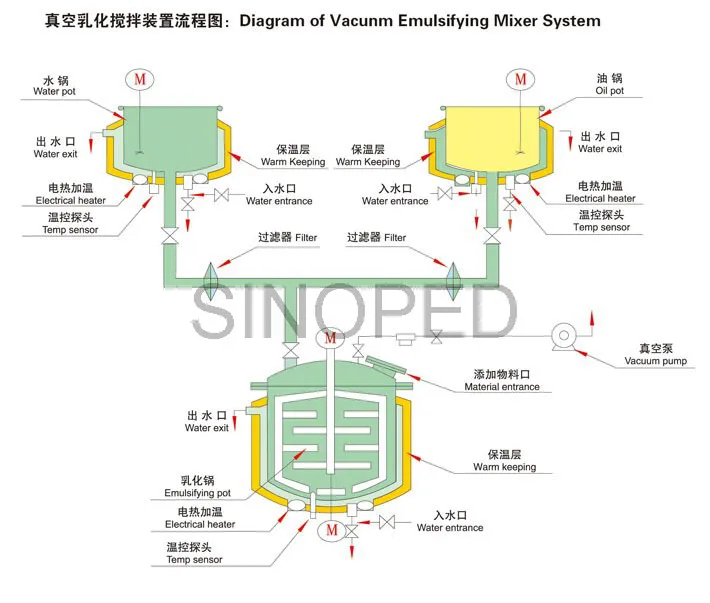
Specifications
| Model | Scraper Stirring Speed (RPM) | Homogenizer Power (KW) | Homogenizer Speed (RPM) | Water Pot Capacity (L) | Oil Pot Dispensing Power (KW) |
| KPZ-100 | 0–86 | 3 | 0–2850 | 60 | 0.55 |
| KPZ-200 | 0–86 | 4 | 100–2950 | 120 | 0.55 |
| KPZ-500 | 0–62 | 11 | 100–2950 | 320 | 1.1 |
| KPZ-800 | 0–62 | 15 | 100–2950 | 480 | 1.5 |
| Technical Parameter | Description |
| Equipment Type | Vacuum Homogenizing Emulsifier |
| Main Material | SUS304 / SUS316L Stainless Steel |
| Vacuum Degree | Up to -0.093 MPa |
| Maximum Processing Viscosity | Up to 100,000 cps |
| Homogenization Particle Size | 0.2–5 μm |
| Mixing System | Scraper Agitator + High Shear Homogenizer |
| Temperature Control | PID Automatic Temperature Control |
| Vessel Structure | Three-layer Jacketed Tank |
| Processing Function | Mixing, Heating, Cooling, Vacuum Emulsification |
Selection Guide
Selecting a suitable vacuum emulsifying machine depends on production volume, material viscosity, formulation characteristics, and required homogenization performance.
For laboratory development and small-batch production, the KPZ-100 model provides a compact solution for formulation testing and pilot-scale manufacturing. The KPZ-200 is suitable for medium production requirements, including cosmetic creams and pharmaceutical formulations.
For industrial manufacturing, the KPZ-500 and KPZ-800 models provide larger processing capacity and higher homogenizer power, making them suitable for continuous production of high-viscosity creams, ointments, coatings, and chemical emulsions.
When selecting a cream emulsifying machine or ointment manufacturing machine, manufacturers should evaluate:
· Batch volume requirements
· Product viscosity
· Required particle size
· Material compatibility
· Cleaning and hygiene requirements
SINOPED can provide customized configurations according to different production processes.
Comparison: Vacuum Emulsifying Machine vs Conventional Mixing Equipment
| Feature | Vacuum Emulsifying Machine | Conventional Mixer |
| Processing Technology | Vacuum + high shear homogenization | Mechanical stirring |
| Emulsion Stability | Higher consistency for complex formulations | Depends on mixing conditions |
| Air Removal | Vacuum deaeration available | Usually no vacuum function |
| High Viscosity Capability | Suitable for up to 100,000 cps materials | Limited for thick materials |
| Particle Size Control | Fine dispersion capability | Limited shear effect |
| Temperature Management | Integrated heating/cooling with PID control | Usually external control |
Compared with traditional mixers, a vacuum homogenizer provides better control of particle dispersion, air removal, and temperature conditions, making it more suitable for high-value formulations requiring consistent quality.
Applications
The SINOPED Vacuum Emulsifying Machine is widely used in industries where stable emulsification and hygienic processing are important.
In the cosmetic and personal care industry, the equipment is commonly applied for manufacturing face creams, lotions, sunscreens, shampoos, toothpaste, facial cleansers, and other skincare products. The vacuum homogenization process helps achieve smooth texture and uniform ingredient distribution.
In pharmaceutical manufacturing, the machine is used for producing medicinal ointments, topical creams, and high-viscosity pharmaceutical emulsions. The sealed processing environment helps reduce contamination risks and supports hygienic production requirements.
For food processing applications, vacuum emulsifiers are used for products such as sauces, cheese products, baby food, chocolate-based materials, and oral liquid formulations where consistent mixing and stable emulsification are required.
The chemical industry also applies this equipment for producing latex, paints, coatings, adhesives, resins, and detergent products.
Installation & Maintenance
Correct installation and regular maintenance are essential for maintaining the performance of a high shear homogenizer.
Before commissioning, the equipment should be installed on a stable foundation with proper electrical connection, vacuum pipeline installation, heating and cooling system connection, and sufficient operating space. Operators should check the rotation direction of motors, sealing performance, temperature sensors, and vacuum system before production.
During daily operation, the homogenizer head, mixing components, and product-contact surfaces should be cleaned according to production requirements. Regular inspection of mechanical seals, valves, vacuum pipelines, and electrical control components helps prevent unexpected downtime.
For pharmaceutical and cosmetic applications, cleaning procedures should follow the user's internal GMP management requirements.
Industry Standards and Compliance
The design and manufacturing of SINOPED Vacuum Emulsifying Machines can be configured according to different industry requirements and international market standards.
| Standard | Application |
| GMP Requirements | Pharmaceutical and cosmetic hygienic production |
| ISO 9001 | Quality management system |
| ISO 14001 | Environmental management system |
| ASME BPE | Hygienic equipment requirements for pharmaceutical applications |
| CE Requirements | European equipment safety compliance |
| FDA Material Requirements | Food and cosmetic contact material requirements |
For applications involving pharmaceutical, biotechnology, or high-cleanliness production, SUS316L stainless steel contact parts and customized sanitary designs can be selected.
Troubleshooting
During operation of a vacuum emulsifying machine, common issues are usually related to mixing parameters, vacuum conditions, temperature control, or mechanical components.
| Problem | Possible Cause | Solution |
| Uneven emulsification | Insufficient homogenizing time or incorrect speed | Adjust homogenizer speed and processing duration |
| Excessive bubbles in final product | Vacuum leakage or insufficient vacuum level | Check sealing system and vacuum pump |
| Temperature fluctuation | Sensor or PID parameter issue | Inspect temperature control system |
| Abnormal vibration or noise | Mechanical wear or foreign material | Stop operation and inspect components |
| Material leakage | Seal damage or loose connection | Replace sealing parts |
FAQ
What is a vacuum emulsifying machine?
A vacuum emulsifying machine is a high shear mixing system designed for producing stable emulsions such as creams, ointments, lotions, and pharmaceutical preparations under vacuum conditions.
What industries use vacuum homogenizers?
Vacuum homogenizers are widely used in cosmetics, pharmaceuticals, food processing, and chemical industries where fine dispersion and stable emulsification are required.
Why is vacuum used during emulsification?
Vacuum processing removes trapped air, reduces oxidation, and improves the appearance and stability of emulsified products.
What is the maximum viscosity this machine can process?
The SINOPED vacuum emulsifying machine can process materials with viscosity up to approximately 100,000 cps depending on formulation characteristics.
What is the difference between a homogenizer and an emulsifier?
A homogenizer mainly reduces particle size through high shear force, while a vacuum emulsifying machine integrates homogenization, mixing, vacuum processing, and temperature control into one system.
How do I select the correct emulsifying machine model?
Model selection should consider production capacity, material viscosity, formulation requirements, and required homogenization performance. KPZ-100, KPZ-200, KPZ-500, and KPZ-800 models cover different production scales.
Looking for detailed specifications, pricing, delivery information, or customized equipment solutions?
Contact our International Sales Manager Brucr for professional support regarding pharmaceutical machinery, production equipment, and customized manufacturing solutions.
Sales Manager: Brucr
WhatsApp: +86 13322335577
Our team provides global customers with equipment consultation, technical assistance, and project support.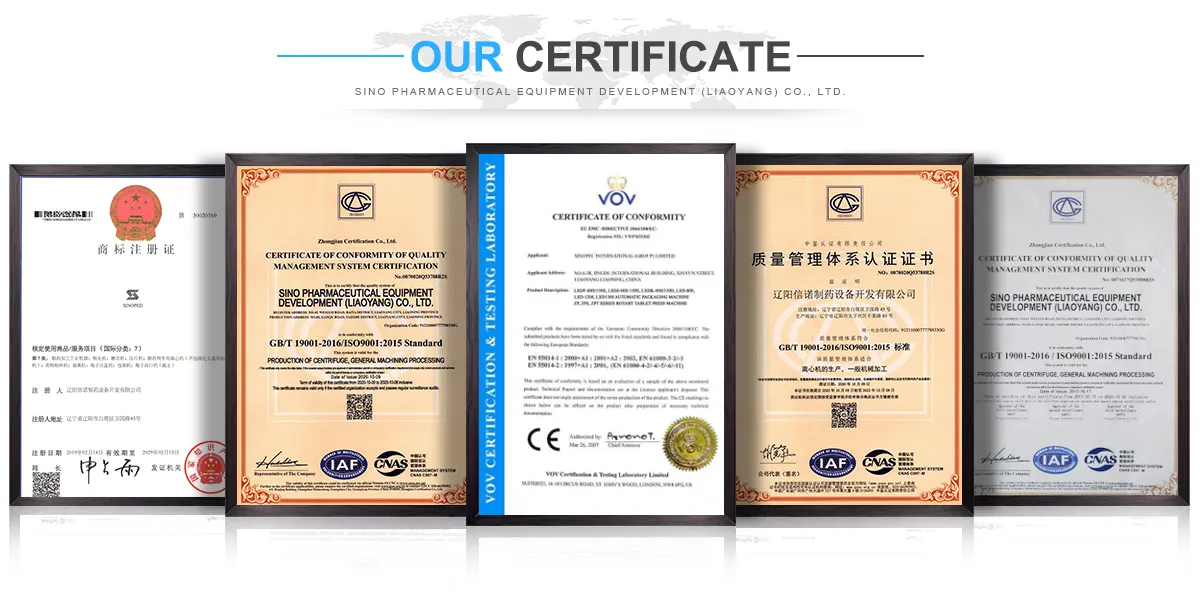
Related products
Image failed to load
YM Series Hammer Pulverizer
Sinoped YM Series Hammer Pulverizer is an aseptic hammer mill designed for pharmaceutical, food, and chemical powder processing. With SUS316L stainless steel options, modular design, adjustable particle size control, and efficient impact crushing technology, Sinoped powder pulverizing equipment provides a reliable solution for manufacturers requiring hygienic and consistent powder production.
Image failed to load
Centrifuge Disc Stack Olive Oil Separator Manufacturer
Sinoped Centrifuge Disc Stack Olive Oil Separator is an industrial centrifugal separation system designed for efficient liquid-liquid and solid-liquid separation. With SS304/SS316 stainless steel construction, automatic discharge options, high separation factors, and multiple capacity models, it is suitable for olive oil processing, food and beverage clarification, pharmaceutical manufacturing, biotechnology, chemical processing, and wastewater treatment applications.The Sinoped disc stack centrifuge combines centrifugal separation technology with automated operation capabilities, providing a reliable solution for modern industrial separation processes.
Image failed to load
GHL Series High Speed Wet Mixing Granulator
The Sinoped GHL Series High Speed Wet Mixing Granulator is an integrated pharmaceutical wet granulation machine designed for efficient powder mixing and granule production. With a sealed horizontal structure, high-speed mixing system, and controlled cutting mechanism, the GHL wet granulator provides a reliable solution for pharmaceutical, food, chemical, and industrial granulation applications.Available models from GHL-5 to GHL-800 support laboratory testing, pilot production, and large-scale manufacturing requirements.
Image failed to load
Spray Dryer Milk Powder Making Machine
Sinoped Spray Dryer Milk Powder Making Machine is an industrial centrifugal atomizer spray dryer used for producing milk powder, food powder, protein powder, and nutritional ingredients from liquid materials. The system combines hot air drying, precision atomization, cyclone powder separation, and PLC automatic control to deliver continuous powder production solutions for food, beverage, and ingredient processing industries.