Image failed to load
Vial Liquid & Lyophilized Preparation Line Manufacturer
Product Overview
Definition
The SINOPED Vial Liquid & Lyophilized Preparation Line is a complete automatic vial filling production system designed for sterile pharmaceutical manufacturing processes, including vial washing, sterilization, liquid filling, rubber stoppering, and aluminum cap sealing.
As an integrated pharmaceutical vial filling line, it is mainly used for producing injectable drugs, vaccines, biological products, and lyophilized powder injections where high sterility control and filling accuracy are required.
The complete vial filling machine system combines ultrasonic vial cleaning technology, high-temperature tunnel sterilization, servo-controlled filling technology, automatic stoppering, and capping processes. The production line is designed according to pharmaceutical GMP requirements to support stable and repeatable sterile drug production.
SINOPED provides customized vial filling solutions for pharmaceutical manufacturers requiring reliable sterile vial filling equipment, flexible production configurations, and efficient pharmaceutical packaging processes.
How the Vial Filling Production Line Works
The SINOPED automatic vial filling line adopts a continuous production workflow, transforming empty glass vials into sealed sterile pharmaceutical containers through multiple controlled processes.
Vial Washing Process
The production process begins with empty vial feeding and ultrasonic cleaning.
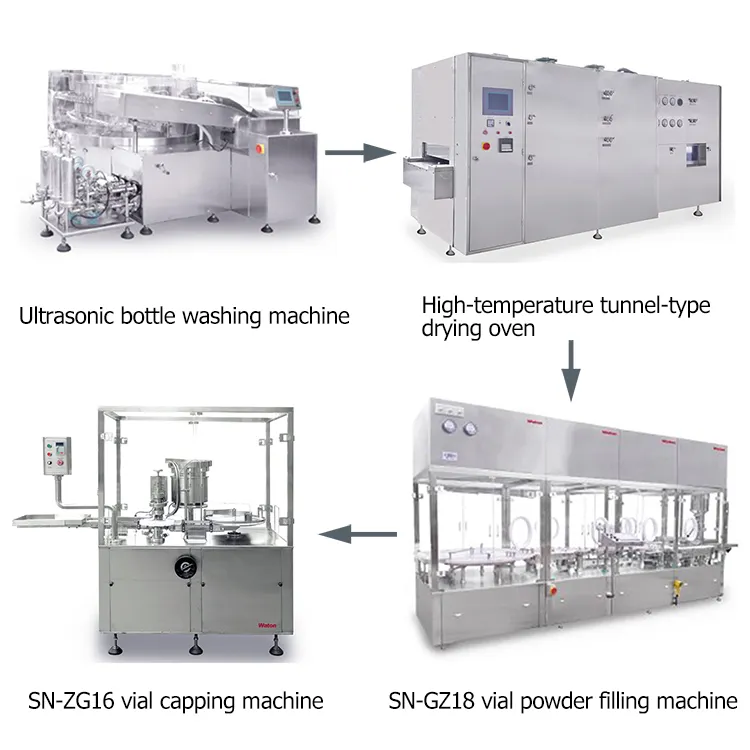
The SNXP ultrasonic vial washing machine uses high-frequency ultrasonic cavitation technology. During operation, microscopic bubbles generated in the cleaning liquid rapidly collapse and create mechanical forces that remove particles, contaminants, and microorganisms attached to vial surfaces.
Compared with traditional mechanical washing methods, ultrasonic vial washing provides a non-contact cleaning process that helps reduce vial damage while improving cleaning consistency.
Sterilization and Depyrogenation Process
After washing, vials enter the hot air circulating tunnel sterilization oven.
The SNHX tunnel oven uses electric heating elements and controlled hot air circulation to provide continuous drying, sterilization, and depyrogenation.
The system maintains a clean airflow environment and transfers heat evenly throughout the vial surface, helping remove moisture and reduce microbial contamination before sterile filling.
This process is especially important for injectable pharmaceutical production where container cleanliness directly affects final product quality.
Filling and Stoppering Process
Following sterilization, vials are transferred into the SNGZ vial filling and stoppering machine.
The filling system uses servo motor control with a peristaltic pump as the standard filling method, while ceramic pump filling is available for applications requiring higher dosing precision.
The machine automatically detects vial positioning and applies a no bottle no fill function, preventing product loss and improving filling reliability.
After filling, rubber stoppers are automatically inserted to prepare vials for final sealing.
Aluminum Capping Process
The final stage is completed by the SNZG16 vial capping machine.
The automatic capping system places aluminum caps onto sealed vials and performs rotary crimping to achieve consistent container closure.
The stable locking mechanism helps maintain sealing integrity for injectable pharmaceutical products during storage and transportation.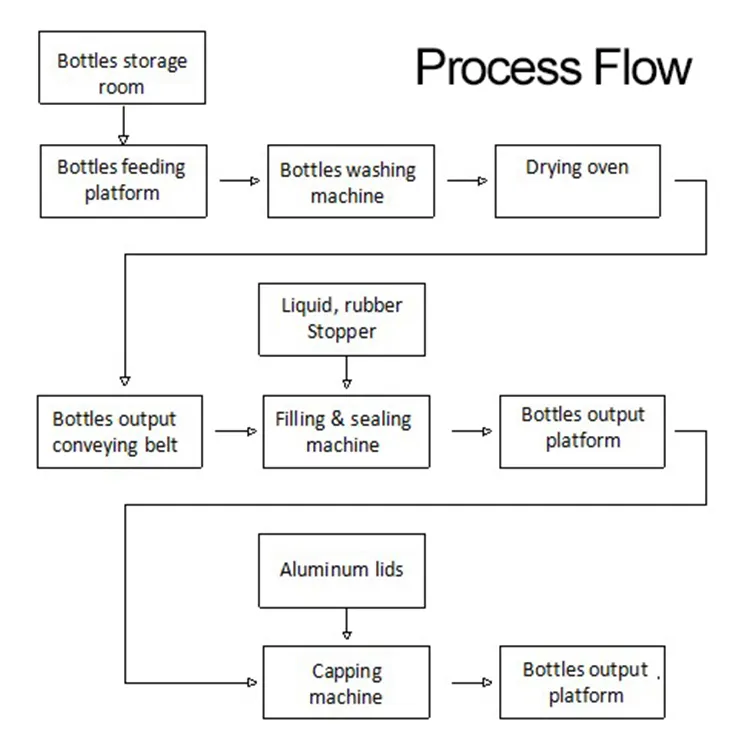
Technical Specifications
| Parameter | Specification |
| Product Name | Vial Liquid & Lyophilized Preparation Line |
| Application | Liquid injection and lyophilized pharmaceutical production |
| Filling Type | Peristaltic Pump / Optional Ceramic Pump |
| Control Method | Servo Motor Control |
| Filling Volume | 1–10 ml |
| Filling Function | No Bottle No Fill |
| Stoppering Rate | ≥99.9% |
| Compressed Air Consumption | 20 m³/h, 3–4 bar |
| Vacuum Consumption | 40 m³/h, -6×10⁻² MPa |
| Power Supply | 380V 50Hz 3P |
| Total Power | 8.8 KW |
| Production Standard | GMP Pharmaceutical Manufacturing Requirement |
Main Equipment Configuration
SNXP Ultrasonic Vial Washing Machine
The SNXP series ultrasonic bottle washing machine is designed for pharmaceutical glass vial cleaning applications.
| Parameter | Specification |
| Model | XP140 |
| Power Supply | 380V 50Hz |
| Power Consumption | 20 KW |
| Water Consumption | 1.4 m³/h |
| Air Consumption | 100 m³/h |
| Bottle Breakage Rate | ≤0.1% |
| Noise Level | ≤70 dB |
SNHX High Temperature Tunnel Sterilization Oven
The SNHX high temperature tunnel sterilization oven provides continuous vial drying, sterilization, and depyrogenation.
The system uses hot air circulation technology with clean airflow control, making it suitable for sterile pharmaceutical environments requiring consistent temperature distribution and contamination control.
SNGZ Vial Filling and Stoppering Machine
The SNGZ series vial filling machine is developed for liquid pharmaceutical filling applications.
The equipment adopts advanced servo control technology and supports different filling systems according to drug characteristics.
Its modular design allows pharmaceutical manufacturers to configure the machine according to production requirements, filling accuracy expectations, and product characteristics.
SNZG16 Vial Capping Machine
The SNZG16 automatic vial capping machine is designed for injection and lyophilized powder vial sealing.
The rotary capping structure provides stable aluminum cap locking and supports continuous pharmaceutical packaging operations.
Selection Guide for Vial Filling Machines
Selecting the correct pharmaceutical vial filling line depends mainly on product characteristics, production capacity, filling accuracy requirements, and regulatory requirements.
For conventional liquid injections, the peristaltic pump configuration provides flexible operation and easy cleaning. For high-value pharmaceutical products requiring tighter dosing control, ceramic pump systems can be considered.
For lyophilized pharmaceutical products, the filling and stoppering configuration should be selected together with freeze-drying process requirements to ensure compatibility between filling, stopper insertion, and downstream lyophilization operations.
Pharmaceutical manufacturers should also evaluate cleanroom conditions, vial specifications, automation level, and validation requirements before selecting equipment.
Comparison: Automatic Vial Filling Line vs Traditional Filling Methods
| Feature | Automatic Vial Filling Line | Manual Filling |
| Filling Accuracy | Servo-controlled precision filling | Operator dependent |
| Production Capacity | Continuous automated production | Limited efficiency |
| Sterility Control | Designed for GMP sterile production | Higher contamination risk |
| Process Integration | Washing, sterilization, filling and sealing integrated | Separate operations |
| Labor Requirement | Reduced manual operation | Higher manpower demand |
Applications of SINOPED Vial Filling Line
The SINOPED pharmaceutical vial filling production line is widely applied in sterile pharmaceutical manufacturing.
It is commonly used for injectable medicines, vaccines, biological drugs, antibiotics, hormone preparations, and lyophilized powder injections.
Due to its integrated washing, sterilization, filling, stoppering, and capping functions, the system is suitable for pharmaceutical companies, biotechnology manufacturers, research institutions, and contract manufacturing organizations (CMOs).
Installation and Maintenance
The vial filling line should be installed in a pharmaceutical production environment that meets cleanroom requirements.
Before operation, users should verify electrical connections, compressed air supply, vacuum system performance, purified water availability, and equipment alignment.
Routine maintenance mainly focuses on cleaning product contact parts, checking filling accuracy, inspecting sensors, maintaining pump components, and verifying sealing performance.
Regular calibration and preventive maintenance help maintain stable operation and support long-term pharmaceutical production reliability.
Industry Standards and GMP Compliance
The SINOPED vial filling production line is designed according to pharmaceutical manufacturing requirements and supports GMP-compliant production environments.
The equipment design considers:
· Pharmaceutical GMP requirements
· Hygienic equipment construction principles
· Sterile production process control
· Cleaning and validation procedures
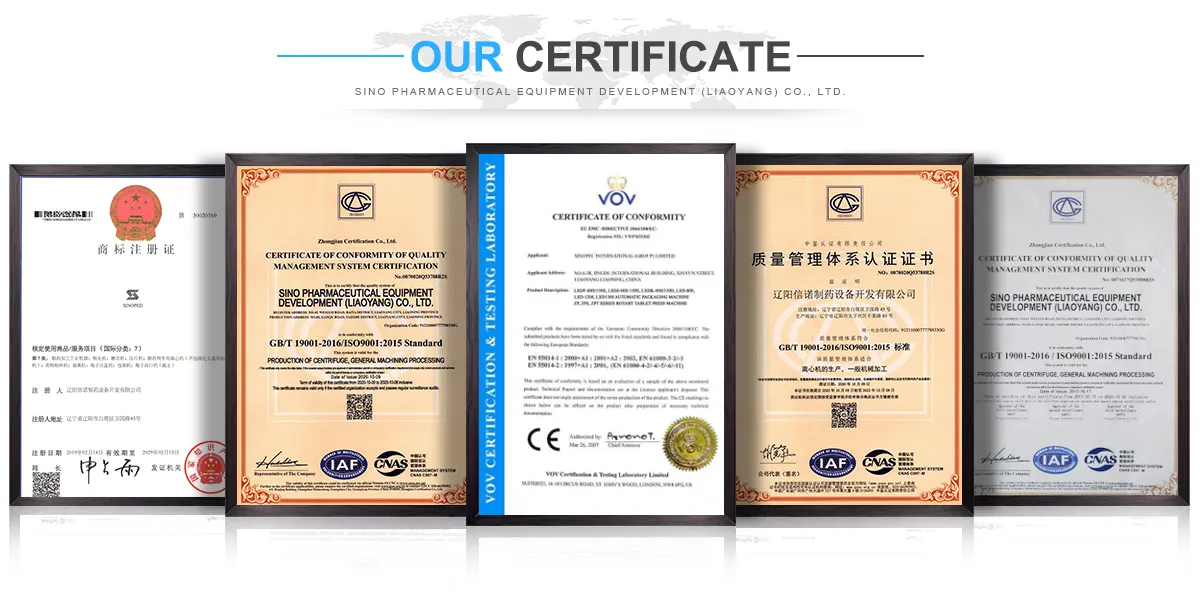
For international pharmaceutical projects, manufacturers may combine the equipment with quality systems such as ISO 9001-based manufacturing management and regional pharmaceutical regulatory requirements.
Troubleshooting Guide
| Problem | Possible Cause | Recommended Solution |
| Filling volume variation | Pump calibration deviation | Recalibrate filling system |
| Bottle breakage during transport | Incorrect conveyor adjustment | Adjust bottle handling system |
| Incomplete vial cleaning | Ultrasonic parameter issue | Check washing system settings |
| Stopper positioning failure | Stopper feeding problem | Inspect stopper mechanism |
| Loose aluminum cap sealing | Incorrect crimping pressure | Adjust capping parameters |
Frequently Asked Questions
What is a vial filling line?
A vial filling line is an automated pharmaceutical production system that performs vial washing, sterilization, drug filling, stoppering, and sealing processes for sterile injectable products.
What products can be produced by this vial filling machine?
The SINOPED vial filling machine is suitable for liquid injections, vaccines, biological medicines, and lyophilized pharmaceutical preparations.
What filling technology does the machine use?
The standard configuration uses a peristaltic pump filling system, with ceramic pump options available for applications requiring higher filling precision.
Is the vial filling line GMP compliant?
Yes. The system is designed according to pharmaceutical GMP manufacturing requirements and incorporates hygienic design principles for sterile production.
Can the system produce lyophilized injections?
Yes. The production line supports vial filling and stoppering processes commonly used before freeze-drying operations.
Why choose SINOPED vial filling equipment?
SINOPED integrates vial washing, sterilization, filling, stoppering, and capping technologies into one complete pharmaceutical production solution, helping global pharmaceutical manufacturers improve production consistency and process control.
Contact our International Sales Manager Brucr for professional support regarding pharmaceutical machinery, production equipment, and customized manufacturing solutions.
Sales Manager: Brucr
WhatsApp: +86 13322335577
Our team provides global customers with equipment consultation, technical assistance, and project support.